During my participation in Viva Technology 2025 in Paris, Europe’s biggest tech event, I decided to run a small personal experiment:
How do we perceive, react, and mentally navigate such complex, information-rich environments?
More than just attending as a researcher and entrepreneur, I observed myself, my eye tracking data, my focus, and my fatigue to better understand how humans interact with complexity and novelty in such large-scale technological gatherings.
👁️ Where Do We Look?
One of the first questions I asked myself was:
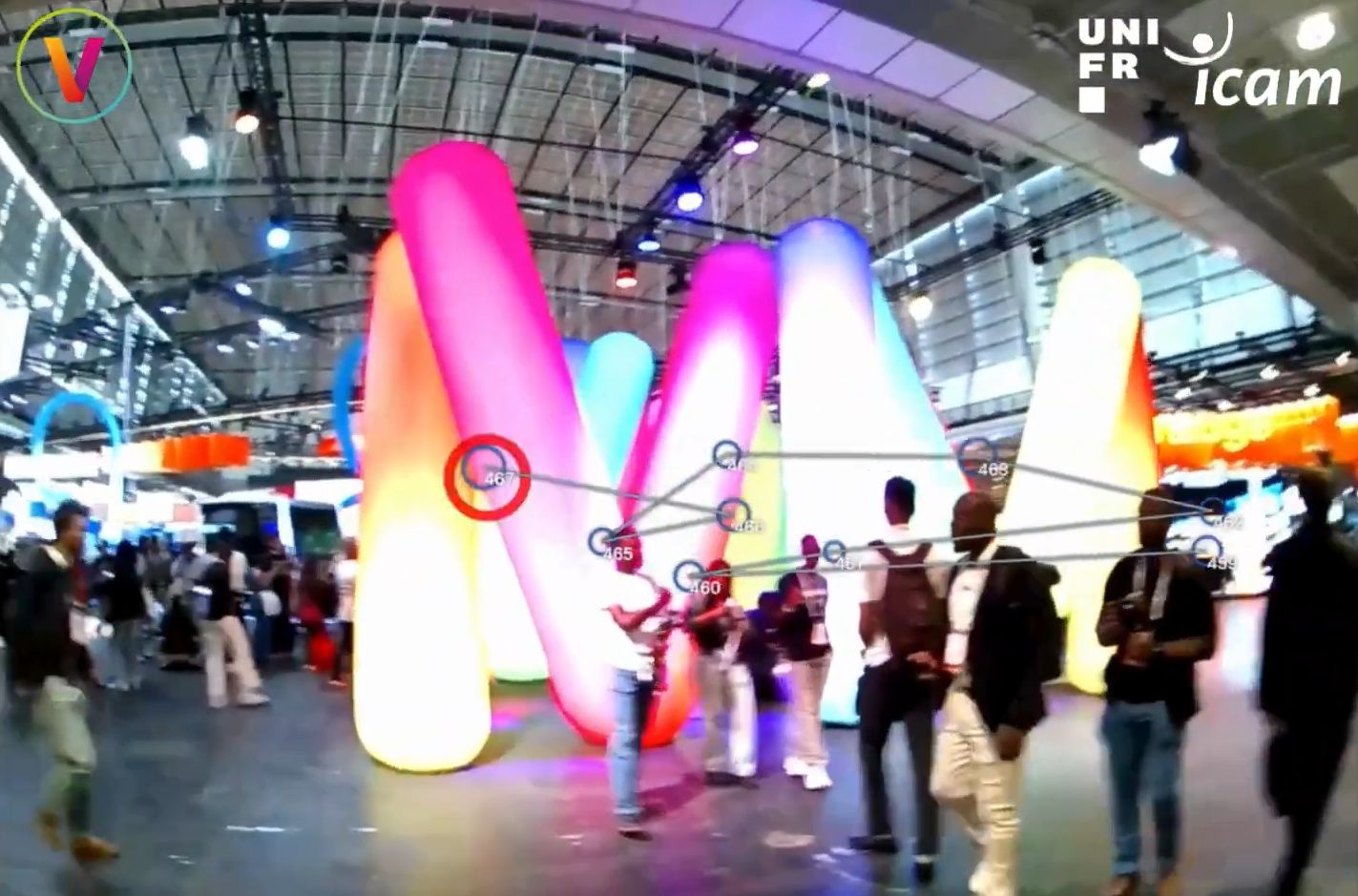
Where does our gaze fall when we enter a hall flooded with colors, lights, people, and ideas?
In a space filled with vibrant booths, robotic demonstrations, digital screens, and an endless flow of visitors, our attention is constantly pulled and redirected. The eye naturally seeks motion, then color, then text, but always within the limits of mental capacity and relevance.
Using Pupil Lab EyeTracker, below are some results of my eye tracking and focusing.
This spontaneous scanning process, what we notice and what we ignore, isn’t random. It’s a survival mechanism that helps our brain prioritize information, especially when overloaded. It also reflects our inner goals, interests, and cognitive biases.
🧭 How Do We Navigate?
Walking through VivaTech is like navigating a maze of innovation. Some stands catch your eye, some you pass by without noticing. Over time, I realized that:
- We follow mental filters: we pay attention to what we know or relate to.
- We make quick decisions: stay 10 seconds or 2 minutes, based on the first impression.
- We rarely backtrack: once it’s gone, it’s gone. Our memory keeps only fragments.
🧠 Why Do We Feel So Tired?
By the end of the day, like many others, I felt exhausted, not just physically, but mentally. This fatigue is not surprising:
- Our brain is constantly filtering and learning.
- Every booth is a new context, a new idea, a new interface, a new concept.
- The dopamine curve of surprise and novelty rises quickly but crashes just as fast.
This aligns with one of our research questions:
How does the brain manage learning, exploration, and cognitive load in high-density, tech-driven contexts?
🎓 The Broader Vision: Human Factors in Complex Operations
This self-observation experiment is part of a broader research program I’m leading (Dr. Rabih AMHAZ, multimodal AI researcher at Icam and iCube Laboratory, University of Strasbourg) with my colleague, Dr. Samy RIMA, a neuroscientist at Fribourg University, Switzerland on:
« Human Factors in Complex Operations Assisted by Technology. »
Whether it’s in industry 5.0, surgery, or driving new automated cars, the human brain remains the key operator in any technological system. Our goal is to study human behavior during complex operations using technologies and multimodal artificial intelligence analysis as world models, but neuromorphic-inspired.
🧩 Final Thought
Events like VivaTech are not just innovation showcases; they are live laboratories of human behavior under cognitive stress.
And if we want intelligent systems to truly assist us, we must start by understanding ourselves better.
Let’s continue the journey toward more human-centered technology.
Have you felt this cognitive fatigue in large events? How do you navigate them?
I am joining VivaTechnology (https://vivatech.com/) this year. What about you?
Let’s discuss.👇
The experiment was done using Pupil Labs Neon Eyetrackers: https://pupil-labs.com/

Related Posts
Master Algorithms and VBA Programming: Free Full YouTube Course
لماذا يجب أن تشاهدوا وثائقي « هجوم نوتبيتيا »؟