Title of the Ph.D. Subject:
Human-Centered AI for Behavior Learning in Industrial Technologies (HABIT)
The HABIT project is positioned at the fault line where industrial performance meets human sustainability. As industrial systems evolve toward Industry 5.0, efficiency-driven paradigms alone are no longer sufficient; they must be complemented by a rigorous understanding of human behavior, cognitive load, and operator well-being within complex production environments. HABIT addresses a structural gap in current industrial technologies: the lack of objective, scalable, and fine-grained models capable of learning from real human behavior as it unfolds in situ. By grounding behavioral analysis in multimodal observations, combining perception, motion, interaction, and neurocognitive description, the project reframes industrial optimization as a human-centered learning problem rather than a purely procedural one. The experiments will take place with a real production line 5.0 at Icam Strasbourg-Europe and experimental research at the iCube laboratory, and reinforced through neuroscientific collaboration with the Human-IST Laboratory at the University of Fribourg (Switzerland), HABIT aims to establish a new generation of adaptive industrial systems that do not merely optimize processes, but understand the humans who operate them quantitatively, ethically, and at scale.
This PhD offer is provided by the ENACT AI Cluster and its partners. Find all ENACT PhD offers and actions on https://cluster-ia-enact.ai/.
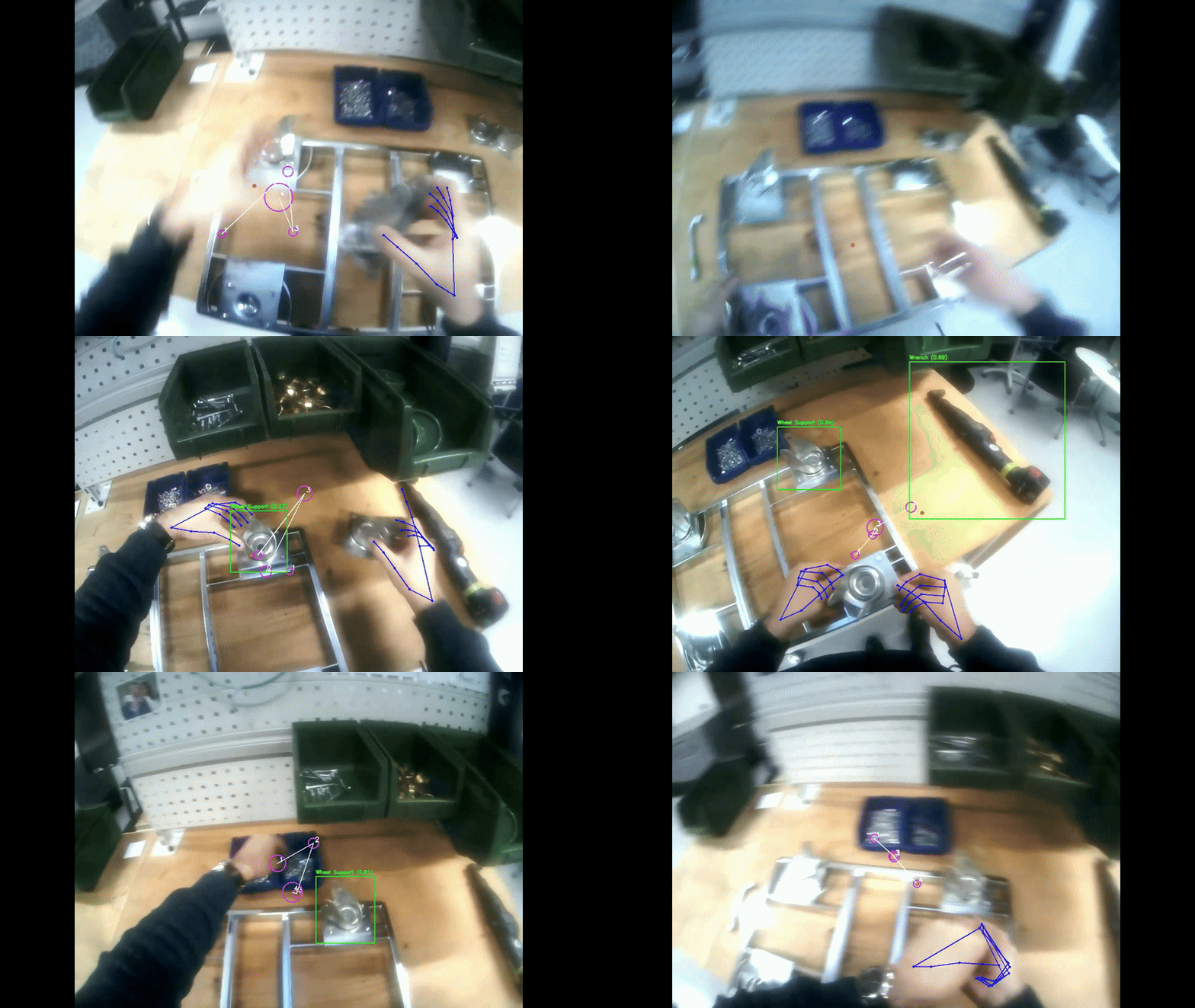
The transition towards Industry 5.0 requires a significant shift in focus, emphasizing human-centricity alongside operational efficiency. While strategies for industrial optimization, such as the Kaizen organization depicted in the above animated figures, successfully reduce process times, it is imperative to rigorously quantify their impact on operators’ cognitive load and mental health. Traditional methods for studying human behavior often rely on subjective observations or limited datasets, which inadequately capture the complex interplay between physical interactions and cognitive states. Therefore, this research project seeks to establish an advanced Human-Centered AI framework that objectively analyzes and learns from human behavior by utilizing multimodal data fusion.
The proposed framework will synthesize various data streams, including eye tracking (blinks and fixations), Inertial Measurement Units (IMUs), video recordings, and neuroscience-based annotations, providing profound insights into behavioral patterns and cognitive processes. Initial research has commenced through multiple M2 internships that have established foundational tools for analyzing diverse behavioral data, thereby laying a robust groundwork for further inquiry.
The PhD candidate will concentrate on collecting, processing, and representing these data, simultaneously examining existing analytical techniques. This investigation will particularly emphasize methodologies rooted in pattern recognition, sequence modeling, and graph-based representations, adapting each approach to address the complexities of heterogeneous data and enhance performance. Beyond simple adaptation, the candidate will strive to develop novel methods for data representation and analysis that will facilitate the identification of behavioral patterns across varied input sources. The effectiveness of this framework will be assessed in real-world situations, taking essential factors such as scalability, reliability, and ethical implications into account.
To deliver a comprehensive understanding of human behavior, this project will feature strong collaboration with neuroscientists at Fribourg University, which provides access to datasets collected in diverse scenarios using advanced equipment. The PhD candidate will collaborate across three strategic sites: the ICube laboratory, Icam Strasbourg-Europe in Schiltigheim, and the University of Fribourg, Human-IST Laboratory.
The expected outcomes of this research include:
(1) a robust framework for analyzing and understanding human behavior through multiple data sources,
(2) insights into the efficacy of different analytical techniques, and
(3) potential applications across various fields, such as healthcare, industry, education, and human-computer interaction, demonstrating the connection between industrial processes and operator well-being.



Bibliographical References:
- Ego-Exo4D: Understanding Skilled Human Activity from First- and Third-Person Perspectives, 2023 https://doi.org/10.48550/arXiv.2311.18259
- Shaoyue Wen et al. (2025) AdaptiveCoPilot: Design and Testing of a NeuroAdaptive LLM Cockpit Guidance System in both Novice and Expert Pilots https://doi.org/10.48550/arXiv.2501.04156
- Yuhong Z., Shilai Y., From (2024) Word Embedding to Reading Embedding Using Large Language Model, EEG and Eye-tracking https://doi.org/10.48550/arXiv.2401.15681
- Deng, R., Gao, Y. A review of eye tracking research on video-based learning. Educ Inf Technol 28, 7671–7702 (2023). https://doi.org/10.1007/s10639-022-11486-7
- Borys, M., Plechawska-Wojcik, M. et al. Classifying cognitive workload using eye activity and eeg features in arithmetic tasks. In: Information and Software Technologies. pp. 90–105. Springer International Publishing, Cham (2017)
- Santosh Kumar Yadav, Kamlesh Tiwari, Hari Mohan Pandey, Shaik Ali Akbar, (2021) A review of multimodal human activity recognition with special emphasis on classification, applications, challenges and future directions, Knowledge-Based Systems, https://doi.org/10.1016/j.knosys.2021.106970
- Tang, Qin & Liang, Jing & Zhu, Fangqi. (2023). A Comparative Review on Multi-modal Sensors Fusion based on Deep Learning. Signal Processing. 213. https://doi.org/10.1016/j.sigpro.2023.109165
- Ser, J.D., Lobo, J.L., Müller, H., Holzinger, A.: World models in artificial intelligence: Sensing, learning, and reasoning like a child (2025), https://arxiv.org/abs/2503.15168
- Xiang, J., Gu, Y., Liu, et al.: Pan: A world model for general, interactable, and long-horizon world simulation (2025), https://arxiv.org/abs/2511.09057
- Chen, Q., Qi, J.: Eye gaze tells you where to compute: Gaze-driven efficient vlms (2025), https://arxiv.org/abs/2509.16476
Profile and skills required
The PhD position is open to candidates holding a Master’s degree in Computer Science, Artificial Intelligence, Applied Mathematics, Data Science, or a related field, who are interested in conducting research in artificial intelligence applied to real-world industrial contexts. The candidate should be motivated to work on applied AI problems involving real data, interdisciplinary collaboration, and practical impact in industrial and human-centered environments. In this context, the candidate is expected to have technical skills as outlined below :
- Good background in machine learning and data analysis.
- Efficient programming skills in Python (and/or similar languages), experience using scientific and AI libraries (e.g., PyTorch, TensorFlow, NumPy, SciPy, scikit-learn) is a plus.
- Knowledge of graph-based methods, representation learning, or structured data modeling.
- Experience with multimodal data (e.g., video, sensor data,…) is suitable.
To candidate :
You can apply to this Ph.D. subject by sending your : (1) CV, (2) two referee contacts (emails)
By mail to Dr. Rabih Amhaz, rabih.amhaz(at)icam.fr & Dr. Samy Rima, samy.rima(at)unifr.ch

Related Posts
Ph.D. AI for Automotive Data

Internship Opportunity: Digital Marketing & Communication